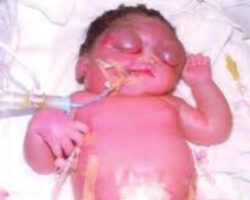
SÃO JOSÉ DE RIBAMAR, MARANHÃO, BRAZIL Brazilian Adalgisa Soares Alves has dedicated more than three decades of her life to caring for her daughter Graziely Alves Régis, who was born with an extremely severe form of congenital hydrocephalus. After her birth, doctors told the family that the girl would probably not survive more than a few months. Despite this prognosis, Graziely is now over 30 years old.
During pregnancy, doctors discovered through an ultrasound examination that cerebrospinal fluid was accumulating in the fetus and that her head was becoming abnormally enlarged. Due to complications, Graziely was delivered by cesarean section.
Shortly after birth, she underwent surgery in which doctors implanted a shunt – a tube designed to drain excess cerebrospinal fluid from the brain. However, her body did not accept the implant, and further treatment was no longer able to stop the progression of the condition.
Today, Graziely is completely dependent on her mother’s constant assistance. She cannot walk or speak, is bedridden, and can only consume a pureed diet given to her through a bottle. She requires round-the-clock care, including feeding, changing, repositioning, and hygiene. Despite this, her mother says that her daughter responds to her presence, hugs, and voice, and can express happiness with a smile.
After more than thirty years of care, Adalgisa continues to find the daily responsibility of looking after her daughter physically and emotionally demanding. In recent years, she has publicly asked for help with funding medical equipment, home adaptations, and assistance with caregiving.
Hydrocephalus, often referred to as “water on the brain,” is a condition in which excessive amounts of cerebrospinal fluid accumulate in the brain’s ventricles. This creates pressure on brain tissue and can cause damage. In newborns, whose skull bones have not yet fused, increased pressure often leads to significant enlargement of the head.
In most cases, hydrocephalus can be treated by inserting a shunt that drains excess fluid into another part of the body. However, if treatment fails or is not possible, the condition can cause severe permanent disabilities, developmental problems, vision loss, limited mobility, and impaired mental abilities. Graziely’s case is among the rare examples of long-term survival with giant congenital hydrocephalus, despite the condition having profoundly affected her entire life.
READ MORE:
https://en.wikipedia.org/wiki/Hydrocephalus